

The Stadium Project
How two football stadiums open a window onto the politics of Bophuthatswana, a former South African homeland created under apartheid.


This edited excerpt is republished with the permission of The Funambulist. The full version appeared in Issue No. 65, “Fifty Years After Soweto.”
On 27 April 1994, Bophuthatswana, the country we grew up in, ceased to exist. We were in primary school at the time and too young to understand that even calling Bophuthatswana a country was a stretch, but that was all we knew at the time. Growing up in Mabopane, at one end of the homeland, and Mmabatho, at the other end, which happened to be the center and seat of power of the homeland respectively, it was indeed another country. Setswana was our unifying language and culture. We had our own flag and our own national anthem, which we proudly sang every morning at school and at “state” events. We had our own television and radio stations: Bop and Mmabatho TV, Radio Bop, and Radio Mmabatho. We even had our own African and Tswana “president,” Lucas Manyane Mangope, who presided from Mmabatho, our capital city.
When 1994 came and the Bantustans—that’s what Bophuthatswana was—were reincorporated into the Republic of South Africa, we were none the wiser that our “country” had really just been an apartheid experiment.
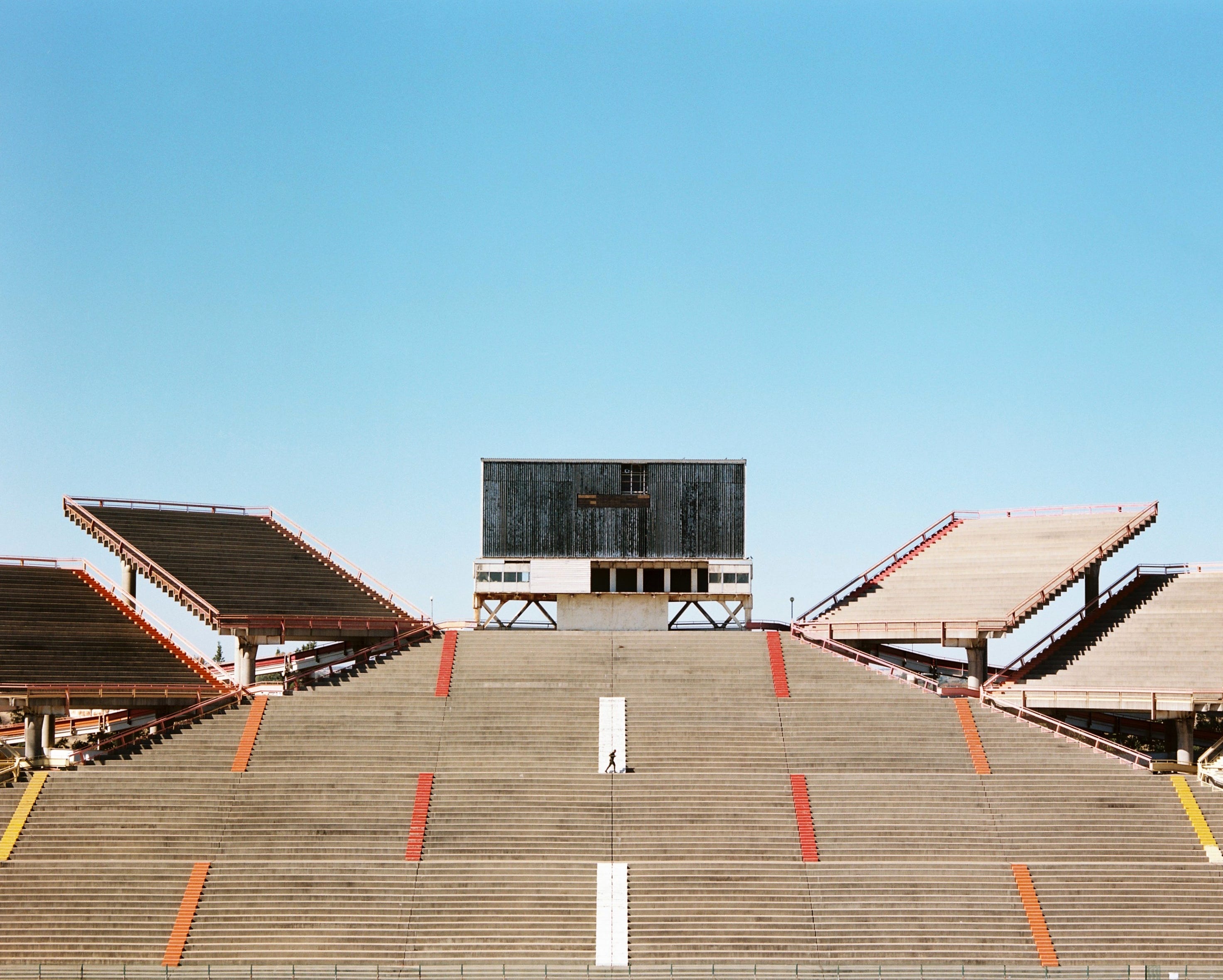
Today it is not hard to find people who grew up in Bophuthatswana and are still nostalgic for a time during apartheid when they were protected from the worst of the regime’s violence while everyone else outside Bophuthatswana had to face it daily. They often mention the good schools, the dignified jobs for local civil servants, cultural and linguistic celebrations and practices, and perhaps most importantly, good infrastructure. Mmabatho and Odi stadiums fit neatly under this last point of infrastructure, but not so much because of their function as opposed to their symbolism. Large and odd-looking superstructures in the landscape at the time, they were something to behold and, in some ways, still are. You can almost see Mmabatho Stadium clearly from 40km outside of Mafikeng because of the flatness of the land and, just like Odi, it grows more and more imposing in presence as one gets closer to it. Indeed, as Boris Groys noted in his study of Stalinism, “monumental propaganda” requires architecture to be harnessed to the service of the state and its ideology. Mangope was certainly aware of this or attuned to it, just as the apartheid regime itself and the colonial British government before it were as they constructed buildings that mirrored old-world Europe and their vision of newly conquered lands.
Mmabatho and Odi stadiums, with their very jarring and brutalist aesthetic, also invoke the “rigid symmetrical design” intended to represent order and discipline, just like the works of Albert Speer in Nazi Germany’s Third Reich and apartheid South Africa’s capital city of Pretoria. Just like Speer’s Third Reich buildings and apartheid’s capital city, there is a coldness to both stadiums, as if human beings are not really who they were intended for.
When we started visiting and photographing Odi and Mmbatho stadiums a few years ago, it was really about finding something to do. At the same time, we were limited to our homes when we were allowed to travel during the COVID lockdown.
For me, Mpho, Mmabatho Stadium held memories of school and provincial athletic events, exhilarating football games that sometimes ended with seats being burned by the fans of the losing side, as well as Nelson Mandela’s first visit to Mafikeng and indeed the whole North-Western part of the country. I remember how he attempted to speak Setswana to us as we gathered in the sun-exposed stands of the stadium pretending to listen. Photography provided, then and now, a way of revisiting those memories as well as pausing long enough to actually look and examine the stadium itself and the type of spatial politics that it contributed to. Speaking to Neo about this immediately triggered her own memories of Odi Stadium, near her own home, and knowing how both stadiums resembled each other, we collectively realized that there were deeper questions to be asked about our hometowns and their histories through these twin structures 300km apart.
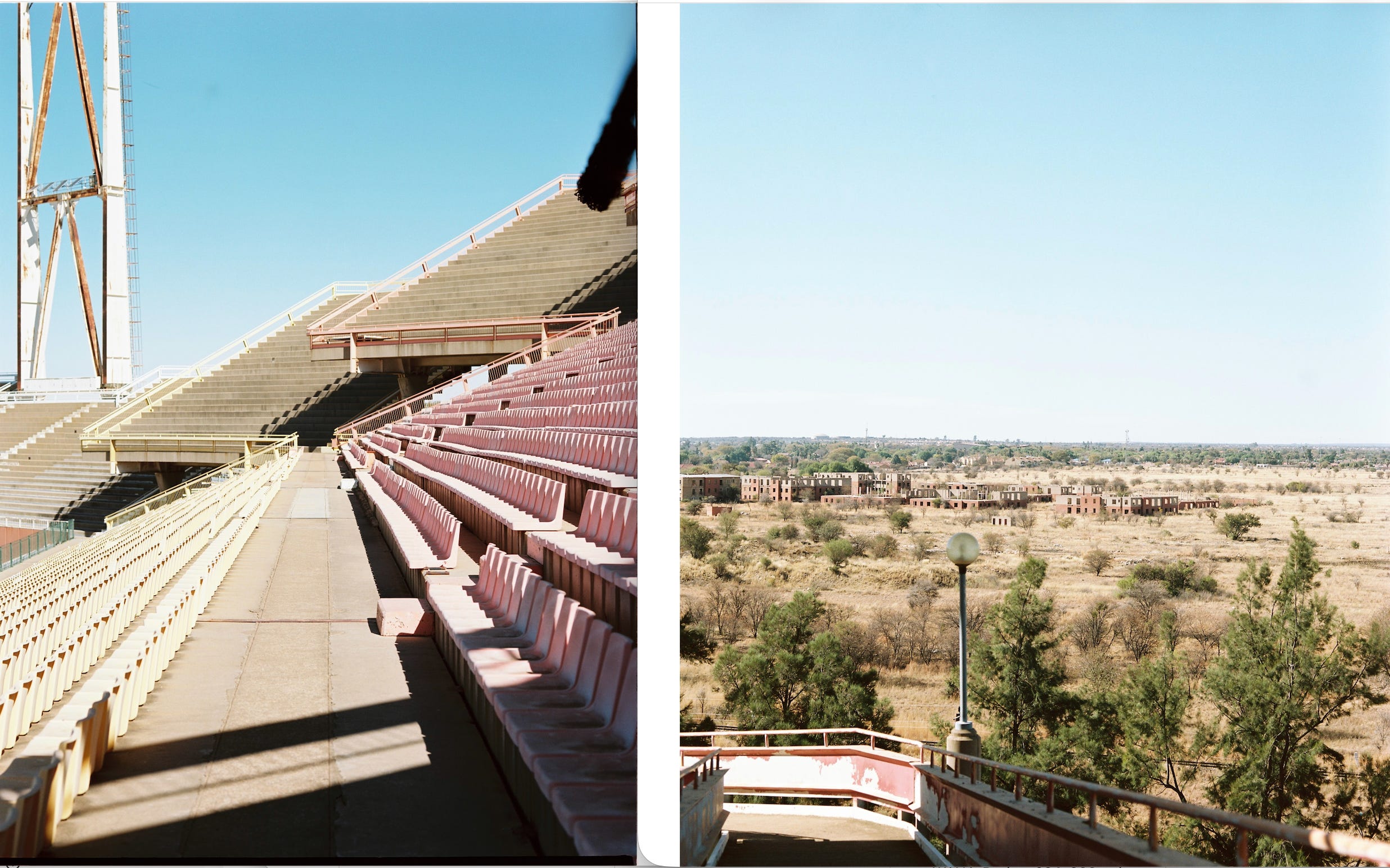
Among our shared memories were those of us playing on the seating stands, which were so high off the ground that one felt vertigo climbing up the stairs and looking down from the top. The exposed walking rails that both stadiums have wrapped around the outsides of their main bodies, starting at the various entrance points and leading up to the seating stands via three levels, were always shaky and uncertain. In any other country, stadiums like this would have been decommissioned a long time ago or required certain alterations to address safety concerns. In fact, it took the FIFA World Cup coming to South Africa in 2010 for the public, especially those of us from the Mmabatho and Mabopane, to realize that those little gut feelings about the safety of the stadiums were correct when FIFA issued a report to that effect and thus ruled them out as venues for official World Cup games. In some ways that was another bursting of the bubble of illusion and nostalgia that “in the homeland, things were better.”
In the early 1980s the Bophuthatswana government awarded LIAT Construction, an Israeli firm, a R96 million contract for the construction of 2,000 houses in Mabopane and the construction of Mmabatho Stadium: “The contract was awarded without going to tender. Again, the job was subcontracted to a South African company, with LIAT reportedly pocketing between R8 million and R15 million in ‘management fees’.” Mangope was accused of accepting kickbacks from LIAT, but the people overlooked this because, in their eyes, things were getting done and they (we) were happily oblivious of the reported R300 million in debt (US $18.2 million) that Bophutatswana was in when awarding the contract, forcing the apartheid government to intervene and help to ease the situation and keep up appearances of a successful Bantustan.
Examining the two stadiums shows how it is almost impossible to tell the difference between them. It seems clear, however, that Odi was somewhat of an afterthought considering how the R96 million contract only covered the building of 2,000 houses and Mmabatho Stadium. Mmabatho Stadium sits just outside the suburb of Unit 1, with the railway line heading to and from Botswana passing right behind it. It also sits right next to the presidential and ministerial estate named Ga Lowe, the mythical place of origin for many BaTswana in South Africa and Botswana. Mmabatho also has many more amenities and infrastructural add-ons that Odi simply did not have, further cementing the idea of it being an afterthought. Today, despite the dilapidation and occasional care, both stadiums are used by their respective communities, who exercise in their venues through individual and group activities.
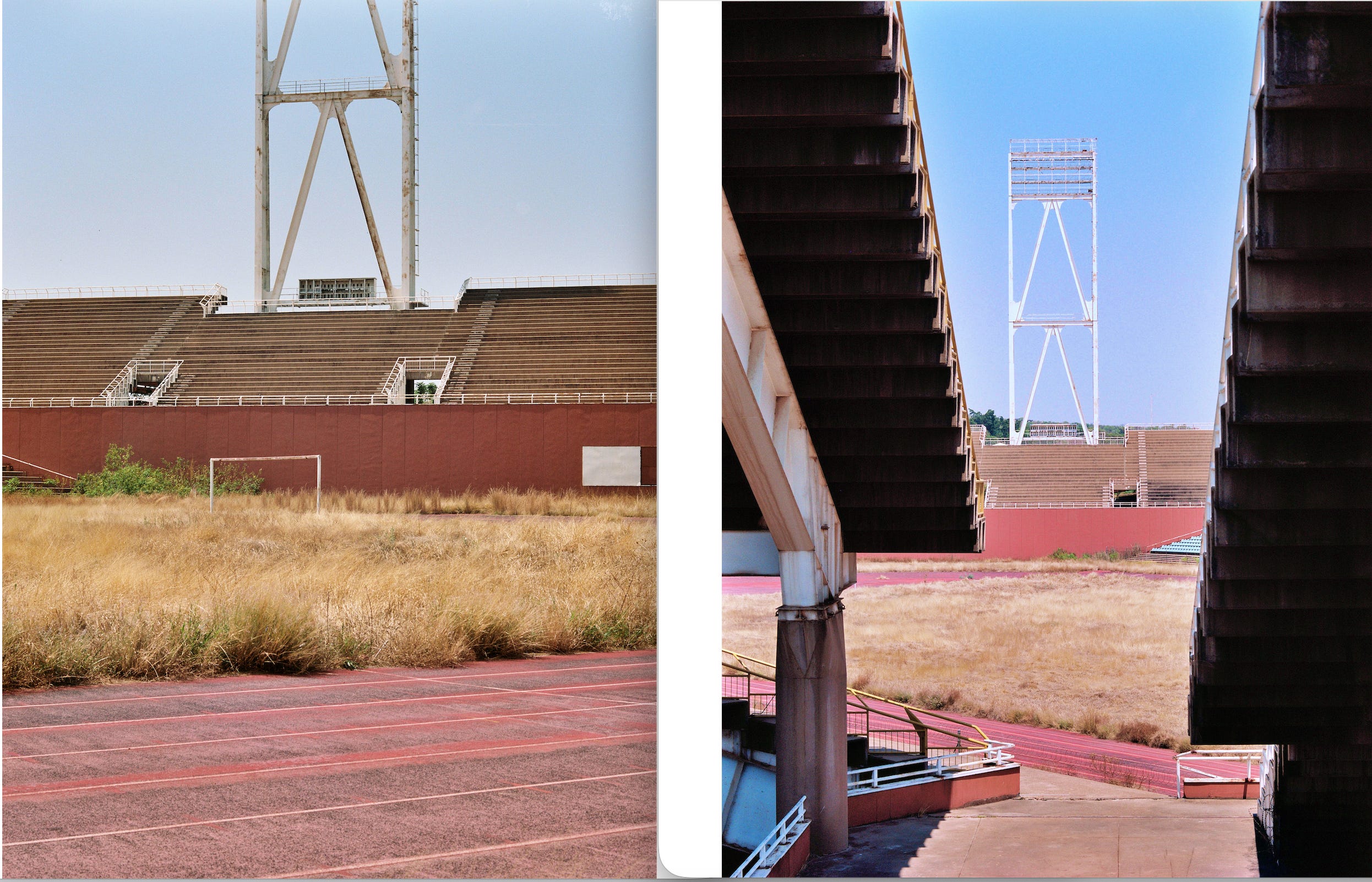
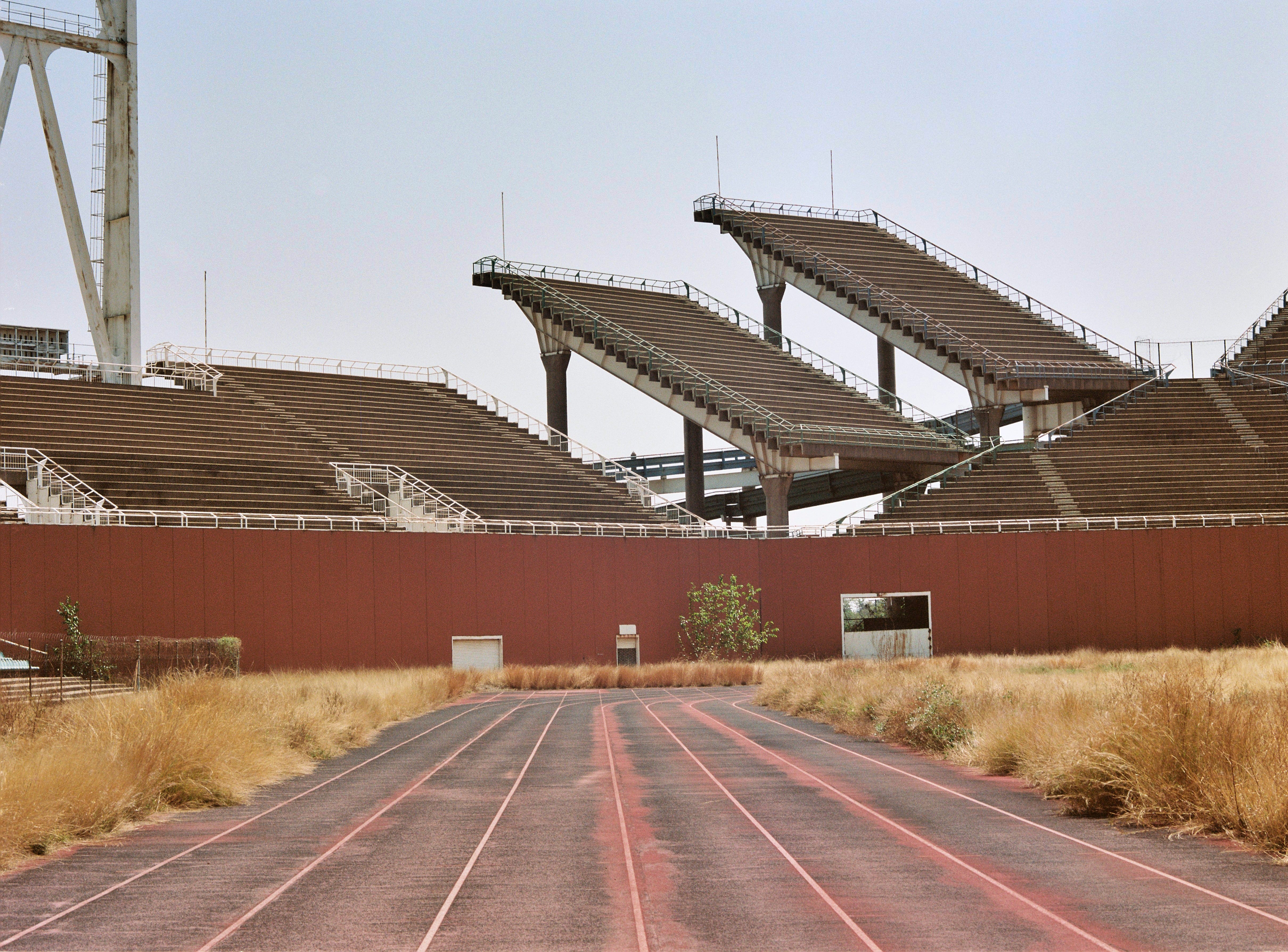
Odi has certainly received the worst hand in terms of fate, however. With its lights, cables, fences, and other movable parts broken and stolen, it is a far cry from Mmabatho Stadium, which has received some care and better security. The reintegration of Bophutatswana and other homelands into South Africa meant that both stadiums had to go through an existential crisis, falling under one “state” before now falling under two separate provinces. Suddenly their enormous size, given their locations, seemed off. The reality of their upkeep became a hard pill to swallow, especially in the absence of either stadium being used for official footballing events. It is little wonder that there has, over the years, been suggestions to demolish both, but in a country with other more pressing issues like unemployment and lack of housing, those suggestions were thankfully challenged and set aside.
An additional shared aspect between Mmabatho and Odi, apart from having the same Israeli architectural firm, is that housing units not far from either stadium seem aesthetically out of place. In Mmabatho, in the Unit 2 suburb, is a block with a distinct design called Beirut. In Mabopane, not far from Odi, two neighborhoods exist next to each other, respectively called Lebanon and Beirut, with the same distinct aesthetic. This revelation— we stumbled upon it, serendipitously—brought up the very cozy relationship that the South African apartheid regime had with Israel but its homelands too. Israel was the only nation-state that explicitly supported the apartheid regime and its homelands when the world sanctioned and isolated it, perhaps because Israel saw itself in the regime.
Bophutatswana even had an embassy in Tel Aviv during the 80s, which Israel welcomed and accepted. It is little wonder that Bophutatswana was considered “Africa’s Little Israel,” as Arianna Lissoni (2011) contends in her 2011 paper “Bophutatswana’s Not So Secret Ties To Israel.” Out of all the homelands—except Ciskei, led by Lennox Sebe—it worked the most with Israel and mirrored its growing ambition of becoming an ethnostate. This was intricately tied to the ambition of its leader, who was a lay-Zionist who openly admired Golda Meir and maintained a holiday home in Tel Aviv.
In our work, we hope to explore questions of memory, nationalism, our own subjectivities, postcolonialism, and apartheid as ongoing colonial mutations from which even the current democratic dispensation borrows in its own “sport for nation building” initiatives and “no DNA, just RSA” mantras, even as we find ourselves led by a Minister of Sports, Arts, and Culture who, much like Mangope, supports the Zionist project.
 | A guest post by
|
 | A guest post by
|