

Superstar
Zinedine Zidane is the first manager in the 122-year history of the French men's national football team who isn't white. He is overqualified for the job.

There has never been a Black, African, or Arab manager of the French national team in its 122-year history. That will change on September 1st, when Zinedine Zidane takes charge. Zidane’s relationship with the national team has been both passionate and complicated—a love affair, as he described in a 2020 interview with L’Equipe: “I want to come full circle with the French national team.” He had just turned 50.
Yet Zidane’s connection to the national team and France’s football elites has often been fraught. As he returns as the prodigal son, how will the nation react—especially given the ongoing discourse within the team itself?
This tension has played out before. After Zidane and his teammates won the 1998 World Cup on home soil, he was pressed to answer questions on race and assimilation. Representatives of the far-right Front National targeted him, declaring Zidane unacceptable to the French. Some far-right figures tolerated Algerian-descended Frenchmen like him only because his father was a harki—a group long stigmatized by many Algerian communities in France for fighting alongside the French army during the Algerian War of Independence (1954–1962).
After Algeria’s independence, harkis fled to France to escape reprisals, reinforcing their image as collaborators with the colonial power. The irony is that Zidane’s family was never part of this history.
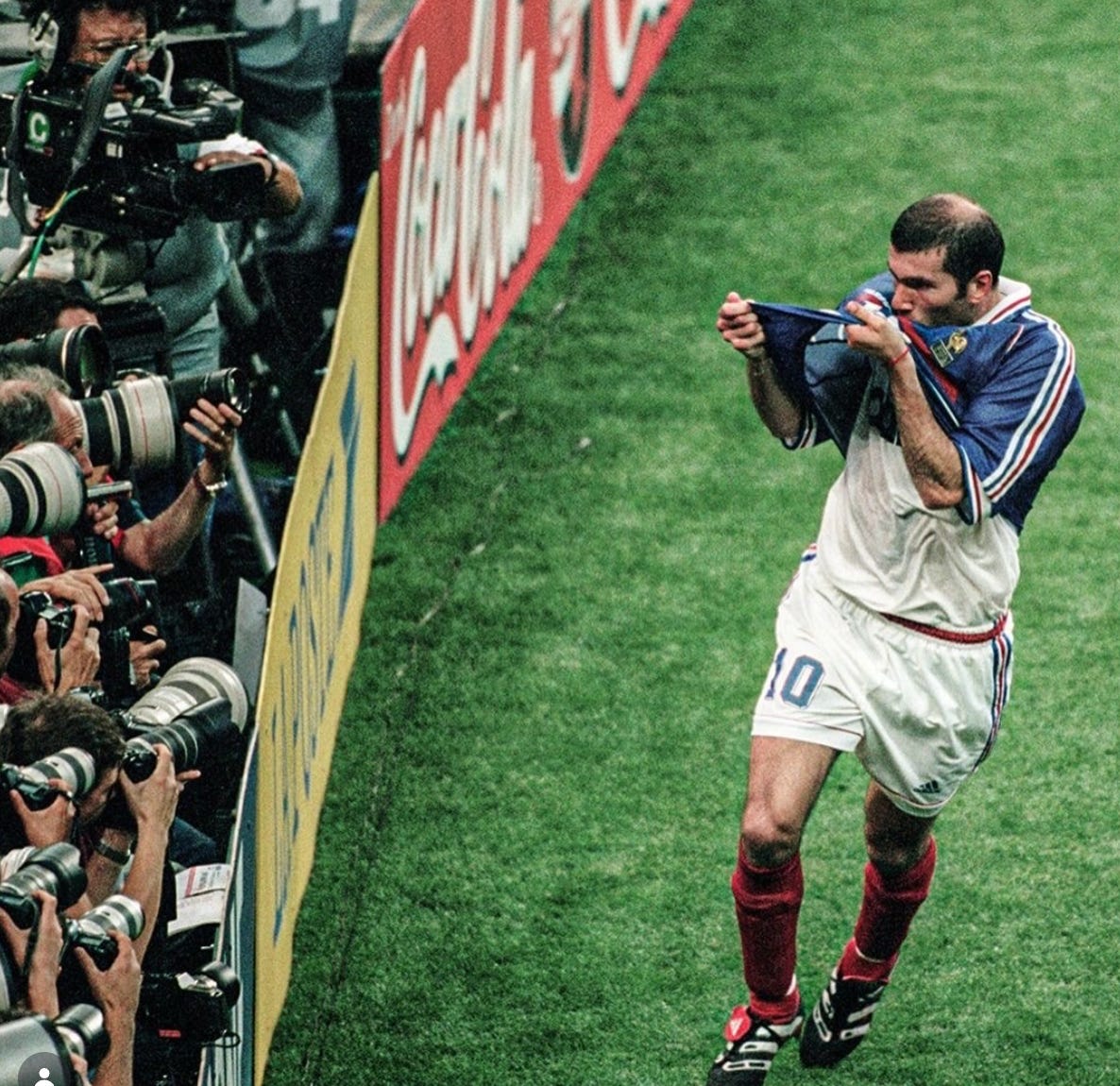
The politics around Zidane’s role have been especially visible in recent years. Zidane’s only experience as a manager is two spells as Real Madrid manager during which he won three straight UEFA Champions League titles and two La Liga titles. An impressive resume. In January 2023, the president of the French FA, Noël Le Graët, publicly dismissed Zidane as a managerial candidate, saying he “would not even take a call” if Zidane wanted the job. Captain Kylian Mbappé quickly countered: “Zidane is France, we don’t disrespect the legend like that.”
Soon after, Le Graët resigned, and in a poetic turn, Philippe Diallo—whose father is Senegalese—became FA president.
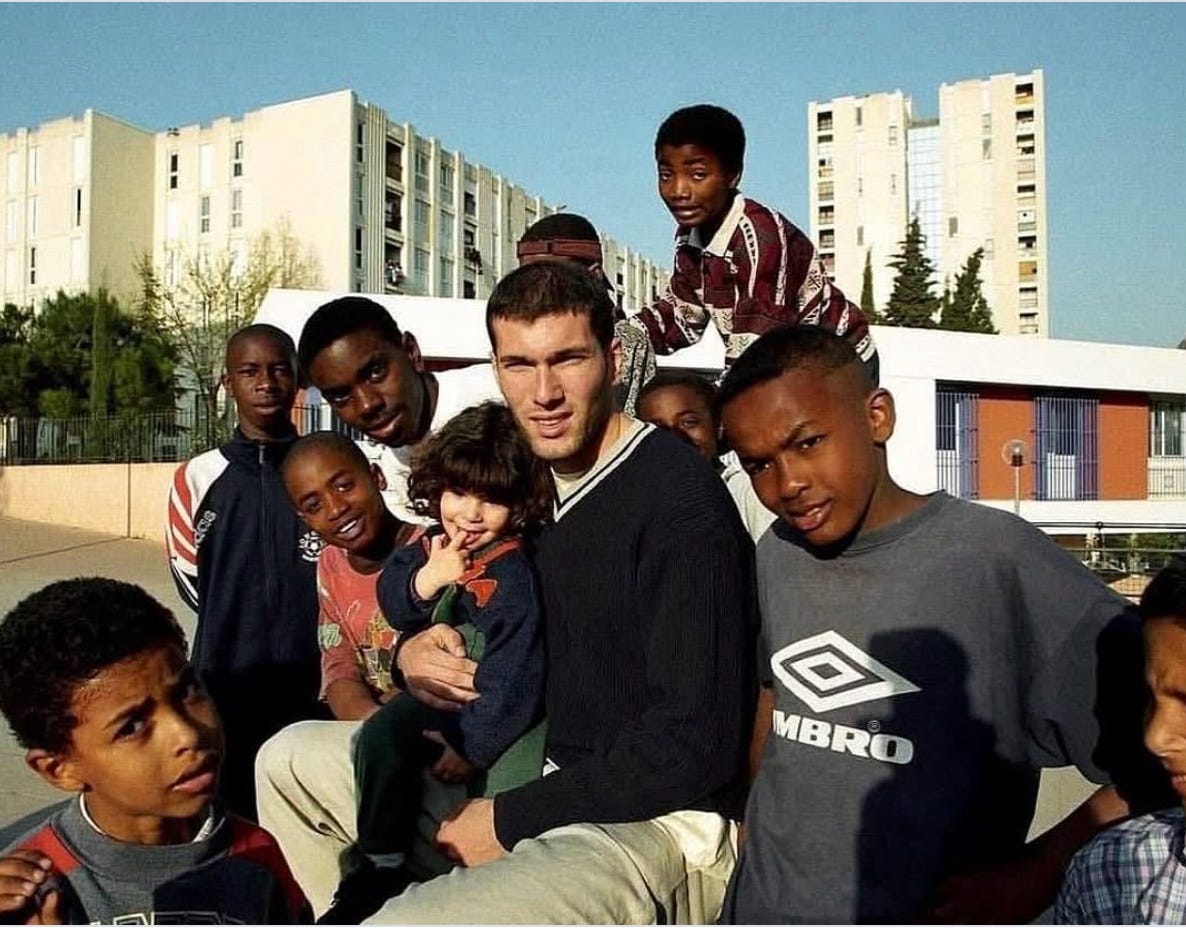
Zidane is also a hero to the French working class. He is the fifth son of Algerian parents who settled in Marseille—the port city that has served as an entry point for many North African families like his.
The slogan that defined the 1998 team — “Black-Blanc-Beur” (“Black, White, Arab”) — became a symbol of multicultural France. The nation celebrates its diverse teams when they win the World Cup (1998 and 2018), but is uneasy when the image strays from the traditional white identity. No one understands this duality better than Zidane.
It is this identity that he must navigate: people question how French Zidane is (despite being born in France), how Algerian he is, and how he fits within the broader Arab-Islamic identity. France’s population is now roughly 10% Muslim.
A son of immigration, Zidane represents the France that will become the predominant one in the future. Even if politicians such as the Le Pens (Jean-Marie and now his disgraced daughter Marine) and the Front National try to divide the nation, it is up to Zizou to regain the spirit of 1998 and 2018. Zidane, though, has shied away from directly criticizing the Le Pens, instead encouraging people to vote, presumably against the Front National.
And as Tony Karon noted on the most recent episode of the limited pod series, World Cup Weekly, Zidane was part of a generation of culturally Muslim players in Europe who did not dare openly profess their faith or identity; very different from the current group of Muslim players.
The tensions between the team and expectations of whiteness will persist, but with the prodigal son at the helm, the reality may begin to shift. Zidane has never been fond of talking — most of his statements were made on the pitch — but managing the national team is a different challenge. As manager, he will no longer have the luxury of sidestepping difficult questions.
Zidane has helped guide transitions before, famously returning from retirement to lead France to the 2006 World Cup final (where the team lost, but he scored an audacious panenka penalty) before being send off for a head but; which was also the last time he played a competitive match.
One man cannot resolve the religious, class, and ethnic divides in one of Europe’s most tense and multiracial societies, but Zidane can try.
In 2004, he told The Guardian: “And, for me, the most important thing is that I still know who I am. Every day I think about where I come from, and I am still proud to be who I am: first, a Kabyle from La Castellane [the poor neighborhood of concrete apartment blocks where he grew up], then an Algerian from Marseille, and then a Frenchman.”
 | A guest post by
|