

Category Four
FIFA's unregulated ticketing is pushing actual fans, especially from developing countries and immigrants from countries where football is woven into daily, to outside stadiums.


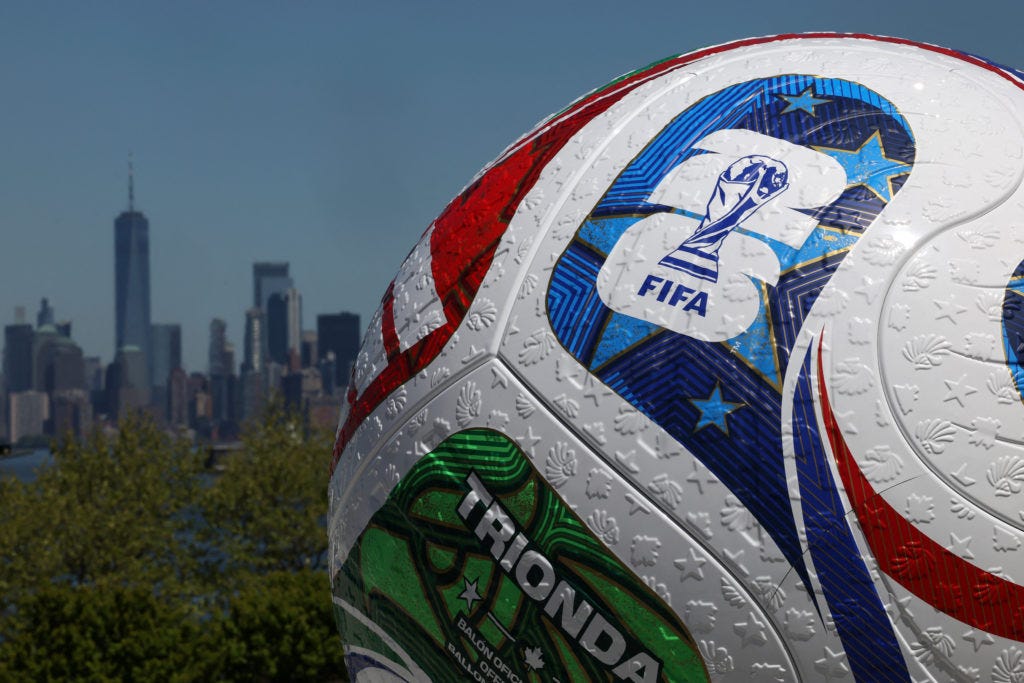
Unlike previous editions, the 2026 World Cup will unfold amid millions of immigrants from countries where football is woven into daily life. The irony is bitter: the World Cup has never been so close, yet never so inaccessible.
Hours spent in virtual queues (sometimes up to four) offer no guarantee of actually securing a ticket. Lower-priced tickets disappear, leaving fans empty-handed after long waits.
Those who miss out and turn to the resale market are in for a greater shock: the cheapest available tickets for the final now start at $4,185 on FIFA’s resale platform, more than seven times the price of the cheapest seat at the 2022 final in Qatar and vastly higher than the roughly $100 entry point for the UEFA EURO 2024 final. Even FIFA’s projected average final ticket price of $1,408 has already been surpassed. And unlike any previous World Cup, this one is being played on the doorstep of nearly two million Brazilians in the US – the largest Brazilian community outside Brazil itself, according to the Brazilian Ministry of Foreign Affairs — along with millions of other immigrants for whom football is a cultural inheritance. Among Brazilian and African fans in our circles, the reaction is immediate: this World Cup feels out of reach, pricing out the ordinary supporters who give the tournament its atmosphere and meaning.
Many of the fans outside the United States who can most easily afford these steep prices are in Europe, and even they are rebelling. Football Supporters Europe (FSE), the continent’s largest fan network, joined the consumer group Euroconsumers to file a formal complaint with the European Commission against FIFA. They argue FIFA has abused its dominant position by imposing excessive prices and opaque buying rules for the 2026 World Cup.
In past World Cups, FIFA made efforts to keep tickets within reach for local fans, like creating special low-cost tickets (“Category 4”) reserved only for residents of the host country. At the 2010 tournament in South Africa, about 15% of tickets were in this category, starting around $20. In 2014 in Brazil, 400,000 such tickets were set aside, starting at $30, with extra discounts (another 50 percent!) for students, seniors, and people on social support. In Qatar, FIFA moved away from tiered ticket pricing but still used some resident-based pricing and phased sales to guide ticket sales.
But then, cheaper tickets weren’t truly accessible for a large fraction of Brazilians or earlier South Africans. Attending the World Cup was difficult for most, but it was within reach for a meaningful share of the population. What we are witnessing in 2026 is a different order of exclusion. The people buying tickets in the resale market are either a tiny economic elite or ordinary fans treating it as a once-in-a-lifetime financial sacrifice.
Where the World Cup is being held has a lot to do with it. The United States has an unregulated ticketing market. Dynamic pricing, resale platforms, and speculative ticket trading are features of American sports and entertainment that fans in Brazil or South Africa never had to navigate. By bringing the World Cup to the US without adapting its ticketing model to the global nature of its audience, FIFA has effectively imported the logic of American sports into an event that has always belonged to the world.
Now, for the first time in World Cup history, FIFA has introduced dynamic (or variable) pricing. Under this model, ticket prices are determined by supply and demand in real time, a mechanism already familiar from airlines, hotels, and ride-hailing apps. At the 2026 World Cup, it works like this: after each sales round, FIFA reads the demand and sets a new, higher price floor for the next round.
It’s an economist’s dream: dynamic pricing is efficient because it helps match supply with demand.
But two major problems with FIFA’s current ticket sales deserve attention. The first is market structure. FIFA is not just the sole seller; it also controls supply. When a single actor controls both supply and pricing, “dynamic pricing” no longer functions as it would in a normal market.
Scarcity also shapes fan behavior. A supporter prepared to pay $200 may suddenly spend $600 or even $1,000 when tickets appear to be disappearing.
The second problem is resale. FIFA’s own resale platform charges 15 percent fees to both buyers and sellers, meaning FIFA profits from every secondary transaction.
To understand what FIFA has done, it helps to understand the market it stepped into. The US live event ticketing market is considered screwed up by fans. Economists Eric Budish and Alan Krueger have shown that music and sports events routinely set low face-value prices in the primary market to maintain goodwill with fans, while the resale market extracts the real price from fans. The profits that should go to performers end up with scalpers and resale platforms instead. No one running the ticketing sales has an incentive to fix this profitable market.
Several solutions could be tested. Budish suggests making tickets non-transferable, like airline tickets, to weaken the resale market. Another option is to reserve a substantial pool of non-resalable tickets at genuinely affordable prices. Journalist Alex Mayyasi proposes a broader model that combines lotteries, rewards for loyal fans, VIP packages, and discounted tickets for supporters who contribute time to youth soccer or to underfunded women’s clubs.
Who could have pushed FIFA to bring the prices down? Football associations are not a realistic pressure point, as they just reelected FIFA President Gianni Infantino. The most promising avenue is public officials in the host countries. Donald Trump, who has shown little concern for high tickets before, but remains highly attuned to polling, told the right-wing New York Post that World Cup tickets are too expensive. This statement, now that most of the tickets have already sold, seems ineffective. But his pronouncements still shape political debate, especially on the right. Apart from the May 7 letter by two Democratic Congresspeople to FIFA, in March, nearly seventy U.S. Congresspeople sent a formal demand to FIFA, criticizing dynamic pricing, artificial scarcity, and misleading seat maps as patterns of potentially deceptive practices. This could have had some effect as new sales rounds took place in subsequent months.
The most popular politician in the US right now is New York City’s mayor, Zohran Mamdani. Unlike most US politicians, Mamdani is an actual football fan. The 2002 World Cup, which Brazil won, was the first he remembered. He rooted for Senegal, which shocked France in the opening match. During his 2025 mayoral campaign, Mamdani promoted his “Game Over Greed” campaign, demanding that FIFA end dynamic pricing, cap resale prices, and reserve 15% of tickets for local residents. He was calling for the measures FIFA implemented in South Africa and Brazil. But even Mamdani knows that FIFA puts profits first, and as the mayor of one of the hosting cities, he can’t do much about it. In the meantime, he declared that all official fan fests would be free, reversing his predecessor’s decision and breaking with the practice of most other host cities.
In the end, Mamdani’s is a modest but pointed act. FIFA prices people out of the stadium; Mamdani puts the game back in the streets. But let’s be honest about what that means: the world’s most popular sport is now accessible to ordinary fans only as a street party, and not because they are far away, but because they cannot afford to walk through the stadiums’ doors.
Something else is emerging from the WhatsApp groups and community chats. Beyond the frustration, beyond the hours spent in virtual queues, a slower realization is taking hold among Brazilians living in the United States. The 2026 World Cup has offered an uncomfortable perception. When there is no Category 4 ticket, no resident discount, and no institutional floor beneath the price, the market does not democratize access. FIFA’s ticketing has become, for many in this community, a blatant encounter with what an unregulated market does when no one sets the rules: it prices out precisely the people whose passion gave the product its value in the first place.
An edited version of a post first published as “Tão perto, tão longe: Fifa expulsa dos estádios quem mais sonhou com a Copa” on UOL.com.br.
 | A guest post by
|
FIFA knows it holds all the cards when it comes to World Cup ticket prices, selling them at exorbitant prices, and it seems no authority or government can stop them. However, it's also true that there's no proven mechanism to offer affordable and democratic tickets. I support what Zohran Kwame Mamdani will do: promote free spaces where many people can watch the matches, although charging a small fee to cover costs wouldn't be a bad idea. Long live football! Let's use this opportunity to make friends.