

Take Me to Your Leader: Kylian Mbappe
Mbappé, in the news over political comments about the Right in France, is hardly radical. Ironically, tech billionaires he admires back right-wing movements that he opposes.


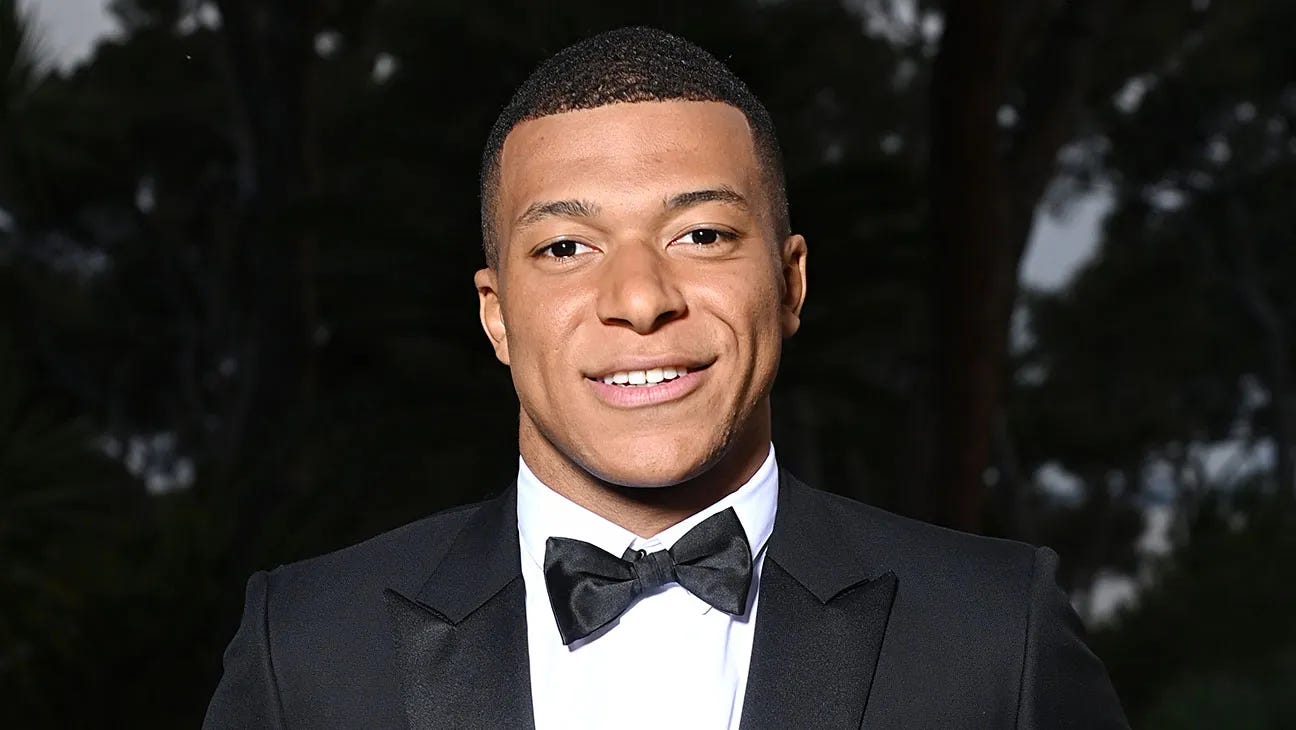
On May 14th, the French Football Federation announced its 2026 World Cup squad. Despite turmoil at Kylian Mbappé’s club, Real Madrid, where he is blamed for the dysfunction on the field and behind the scenes, he retained the French captain’s armband.
Mbappé is also emerging as a leader in more ways than one. On the face of it, he has not shied away from speaking out against the rightward drift in French politics, which mirrors depressing trends across much of Europe. In recent elections, the far right – represented by the National Rally – has come closer than ever to winning both the presidency and a parliamentary majority in France. In 2022, only a tactical alliance between Emmanuel Macron’s centrists and the left prevented Marine Le Pen and the RN from taking power. Jordan Bardella, widely seen as Le Pen’s successor, is currently polling first in the race for the next presidential election, scheduled for April 2027. Bardella is the right’s likely candidate, as Marine Le Pen’s campaign remains uncertain due to an embezzlement conviction she is appealing. Macron, meanwhile, cannot run again because the French constitution limits presidents to two consecutive terms. With no clear centrist successor yet emerging, it remains unclear whether another tactical alliance between the center and the left would be enough to keep Bardella and the RN out of power.
Which is how and where Mbappé re-enters the chat. It is not his first time.
On the eve of the 2024 Euros (eventually won by Italy), the RN captured the largest share of the French vote in the European Parliament elections, winning roughly 31 percent. The result shocked France and prompted Macron to call a snap parliamentary election. Ahead of that vote, Mbappé described the RN’s success as “catastrophic,” urged the public to vote, and warned against “extremes knocking at the door of power.” His teammates, Marcus Thuram of Inter Milan(more on his family later) and Jules Koundé of FC Barcelona, were similarly direct in criticizing the RN. Ousmane Dembélé, along with two white teammates, Benjamin Pavard and Olivier Giroud, offered more indirect criticisms. Mbappé, however, absorbed most of the backlash. It was striking that Antoine Dupont, the white captain of France’s men’s national rugby team, also rejected Marine Le Pen’s politics but did not face nearly the same level of scrutiny or abuse.
Which gets us to now. Last week, Mbappé was profiled by Vanity Fair ahead of the 2026 World Cup. Questions of French identity and the RN surfaced halfway through. The magazine noted that Mbappé’s candor was not unusual, observing that “candor is a quality that distinguishes French athletes from their American counterparts.” Midway through the piece, reporter Aidan McLaughlin recalled how Mbappé, who helped France win the 2018 World Cup, missed the decisive penalty in France’s Euro 2020 defeat to Switzerland and was subsequently subjected to intense racial abuse from French “fans,” severe enough that he considered quitting the national team. “It’s a dynamic that players of mixed identity so often face in France,” McLaughlin writes. “They’re heroes when they win, totems of Gallic pride. When they lose, they are maligned as Africans with no business representing the country.”
Mbappé said the rise of the right shocked him and compelled him to act: “We truly try to fight this idea that a footballer should shut up and play.” The section on politics ends with Mbappé talking about using his foundation, which creates opportunities for working-class and poor children to play football, to effect change. He lists his political values as compassion and solidarity. The piece then moves on to his brand deals.
Except for his comments on the right and on French identity, Mbappé’s political commitments remain relatively vague. This stands in contrast to previous national team captains and other prominent stars, who often articulated clearer public positions. Mbappé’s mother is of Algerian descent (she was born in France, while his father is a Cameroonian immigrant), and he must have been aware of the history of the FLN team, formed in 1958 by Algerian players then active in Ligue 1 to promote the Algerian independence movement through exhibition matches around the world. Among them was Rachid Mekhloufi, a star at Saint-Étienne, as well as three members of the French national team: Mustapha Zitouni, Abdelaziz Ben Tifour, and Saïd Brahimi. It was also widely speculated that several members of the team were in contention for France’s squad at the 1958 World Cup in Sweden.
Black-descended players such as Marius Trésor, Jean-Pierre Adams, and, most notably, Jean Tigana – who finished second in the Ballon d’Or voting in 1984 for his role in France’s Euro 84 championship – came into their own within the national team setup in the 1970s and 1980s. While they were not generally outspoken on politics during their playing careers, several would later, in retirement, reflect on the racial abuse, scrutiny, and persistent questioning they faced from sections of the media and fans regarding their identity and sense of belonging. This period also coincided with the rise of the National Front, led by Jean-Marie Le Pen (Marine’s father), which emerged as a national political force in the 1980s, winning its first seats in the National Assembly and bringing questions of immigration and national identity more forcefully into mainstream French politics.
By the mid-to-late 1990s, Front National was a well-established, influential far-right force in French politics. This happened to coincide with France hosting the 1998 World Cup and famously winning with a team of “Black-Blanc-Beur” (Black-White-Arab). Two years before, during Euro 96, which was played in Britain, Jean-Marie Le Pen told FN supporters that it was “artificial to bring in players from abroad and call them the French national team.” The team included at least seven players with family origins in France’s former or current colonies in the Caribbean, Africa, or the Pacific. Its star was Zinedane Zidane, born in Marseille and of Algerian descent. Le Pen accused most of these players of not singing or not knowing the lyrics to the French national anthem. Michel Platini, who captained the side in the 1980s and was of white Italian descent, said that nobody in his generation, when teams were mostly white, sang or knew the anthem, and it wasn’t a problem.
The captain in 1998 was another player Didier Deschamps (he now manages the team), and since then, except a rotating captaincy between 2010 and 2012 and Hugo Lloris between 2012 and 2022, the national team has been led by Black or Arab-descended players, including Marcel Desailly, Patrick Vieira, Zinedine Zidane, Lilian Thuram (Marcus Thuram’s father and arguably the most explicitly left-leaning of recent French footballers), Thierry Henry, Patrice Evra (he was captain during the disastrous 2010 World Cup which was marred by racist insults against the Black and Arab players in the squad), and Kylian Mbappé. (Earlier, Trèsor, who was born in Guadeloupe in the Caribbean, was captain from 1976 to 1979.) This is obviously giving the Right stress.
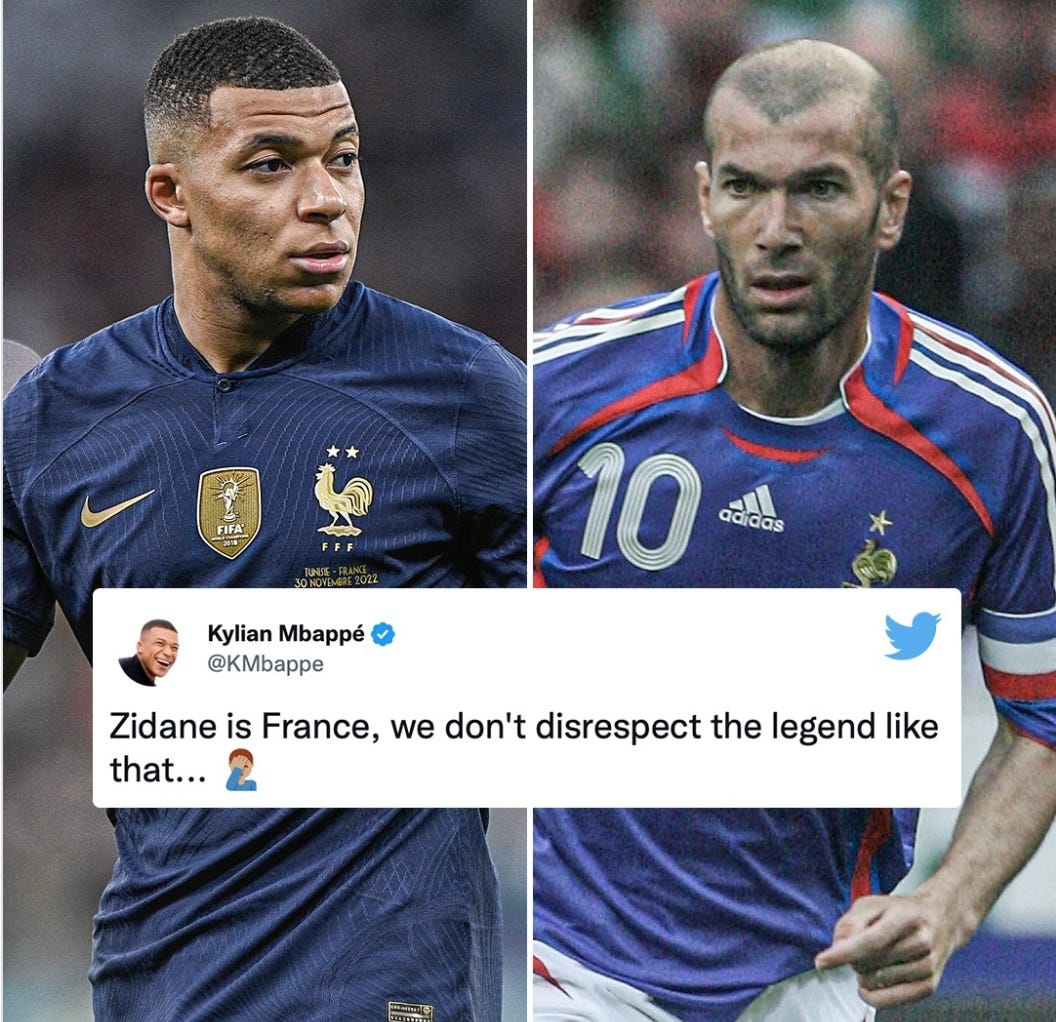
Politically, Mbappé resembles Zidane's political approach more. Zidane has also spoken out against the National Front, in 2002 and again in 2017. In 2002, he said: “But above all, they must think of the consequences that could arise if they vote for a party which does not correspond to French values.” His words closely anticipate the kind of civic appeals that Kylian Mbappé later echoed in his own public interventions.
In 2023, rumors circulated that Zidane was interested in the role of coach of the French men’s national team. Had he been appointed, he would have been the first head coach of North African heritage in the team’s history. Noël Le Graët, then president of the French Football Federation, dismissed the idea out of hand. Mbappé responded on X: “Zidane is France. We don’t disrespect a legend like that.” The statement quickly made headlines and was widely interpreted as contributing to the pressure that eventually led to Le Graët’s resignation. It is suggested Zidane will take over as manager of the national team after the 2026 tournament.
For all his comments about elections, Kylian Mbappé is hardly a radical. Zidane has a similar reputation in France. Mbappé remains deeply invested in branding and image management, reportedly leaving Paris Saint-Germain partly because the club overused his likeness in its marketing without compensation commensurate with his global profile. Silicon Valley-speak about “new values” and “world-changing ambition mostly appeals to him. Ironically, many Silicon Valley tech billionaires he admires have flirted with, enabled, or directly funded right-wing political movements akin to the National Rally.
 | A guest post by
|